
Line of Business & Products
Business Overview
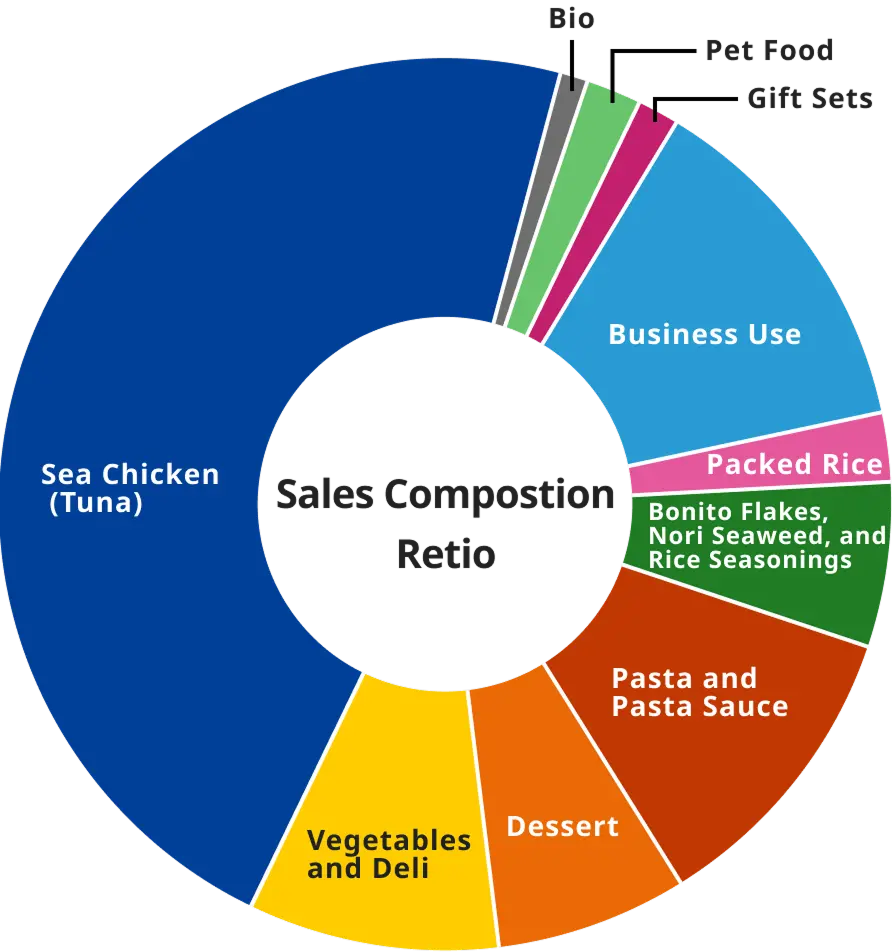
Our Group operates standard food and related businesses as a single segment,
manufacturing and selling various products.

Sea Chicken (Tuna)
Our flagship brand Sea Chicken is the top brand in the domestic tuna market. We sell approximately 40 varieties of products based on fish type, fish meat shape, seasoning liquid type, and container, and approximately 60 varieties when including packed products. We also offer a wide lineup including mayonnaise-type products and fish seasoned with sweet and savory soy sauce flavor.
The Beginning of Our Business
Our business began in 1931 when we produced canned tuna using albacore tuna landed at Shimizu Port (Shimizu Ward, Shizuoka City, Shizuoka Prefecture) and exported it to the United States. In 1958, we named the product Sea Chicken, registered it as the trademark, and started selling it in Japan. Only Hagoromo Foods’ tuna can be called Sea Chicken.

Vegetables and Deli
The Syakitto! Corn series, the top brand of sweet corn, offers roughly a dozen varieties, including whole kernel corn, creamed corn, and no-drain types, to suit various purposes. They come in a wide range of containers, from cans to pouches and paper packs. The Home Cooking series offers a wide range of useful cooking ingredients in convenient sizes and containers.
Additionally, the Kenko (Health) series of prepared mackerel, saury, and sardine products is available not only in cans but also in many pouch types. Furthermore, we are the only distributor in Japan handling King Oscar brand oil sardines and Norwegian mackerel.
The Beginning of Our Business
Syakitto! Corn was launched in 1989. At the time of launch, it was manufactured in the United States, but production in Japan started in 1900. By using frozen raw materials, we were able to manufacture the product year-round, ensuring a stable supply.

Dessert
The Asa Kara Fruits (Morning Fruits) series and Amami Assari (Light Sweetness) series use various fruits such as mandarin oranges, pineapples, and yellow peaches, and are sold in a diverse lineup including cans and pouches.
Additionally, the Japanese Fruits series using such carefully selected domestic fruits as mandarin oranges and white peaches harvested in Japan is also popular.
We offer various desserts, such as boiled azuki beans and zenzai (sweet red bean soup) using carefully selected azuki beans.
The Beginning of Our Business
Shizuoka Prefecture, where our company was founded, was known for its mikan (mandarin orange) cultivation. Around 1932, we manufactured canned tuna using albacore tuna in summer and canned mandarin oranges in winter, which we then exported overseas. Later, we switched to a manufacturing method of repacking imported fruits, and launched Amami Assari in 1981 and Asa Kara Fruits in 1998. In 2004, we launched pouch products ahead of other categories.

Pasta and Pasta Sauce
We sell pasta with a wide lineup tailored to different uses, including our POPOLO-Spa series bundled for a single serving, as well as Sala-Spa and POPOLO Maca. As for pasta sauce, we offer such canned sauces as the classic Meat Sauce and Clams and Vegetables, also a wide variety of pouch-type pasta sauces in our Quick Microwave Pasta Sauce line.
The Beginning of Our Business
After our founding, the canned food business progressed smoothly, but since raw materials are agricultural products, the raw material situation was unstable and factory operations were sometimes inconsistent. Therefore, we aimed to enter a food industry where raw material prices were stable, production and sales could be maintained year-round, and demand was expected to grow in the future. In 1962, considering growing popularity of Western-style cuisine among the Japanese, we examined businesses using wheat flour and ended up entering the pasta business. Our current in-house plant (Mt. Fuji pasta plant) was rebuilt in 2012 and has grown as a core business that supports our company.

Bonito Flakes, Nori Seaweed, and Rice Seasonings
Dried foods, such as dried bonito flakes, nori seaweed, and rice seasonings, have long been familiar foods in Japanese cuisine. To expand demand further, we offer various dried food products that include our dried bonito flake brand Hagoromo Mai, which suggests new uses not only for dashi (soup stock) but also as toppings, as well as roasted nori, seasoned nori, and rice seasonings.
The Beginning of Our Business
In 2005, we incorporated Maruai Corporation, a manufacturer and seller of dried foods, such as dried bonito flakes and nori seaweed, into our group, marking our entry into the dried foods business. In 2021, we renovated our in-house plant (Kisosaki Plant), enabling more efficient production of furikake by manufacturing shaved dried bonito flakes and nori seaweed at the same factory.

Packed Rice
The convenient twin-pack Papatto Rice series offers various types to choose from, including brand rice, such as Koshihikari and softly cooked Yanwaka Gohan.
The Beginning of Our Business
In February 2000, Hagoromo Foods was listed on the Tokyo Stock Exchange (Second Section). To secure more stable profits, we sought to increase the proportion of the businesses for which raw material conditions are relatively stable. In 1998, we commenced operating our own plant (Sunrise plant) and entered the packaged rice business.

Business Use
We provide various food ingredients including Sea Chicken, fruits, and sweet corn to convenience stores and the food service industry, and work together with our customers to develop new menu items.

Gift Sets
We offer gift sets centered on our products suitable for summer and year-end gifts, as well as for casual presents and formal gifts.

Pet Food
For pet owners who cherish their pets as family members, we sell safe and reliable Kazoku Hinshitsu (Family Quality) pet foods manufactured with the same raw materials and quality control as human food, including Muichibutsu, a pet food made only with ingredients and water.
Bio
To make full use of tuna and bonito, we manufacture and sell seasoning stock solution (extracts), fish oil, and animal feed by utilizing the parts that are not used as raw materials for Sea Chicken. Furthermore, we have begun research on functional foods by extracting various components from tuna and bonito.
